A trivially exploitable command-injection vulnerability in the React Native CLI's Metro development server is being actively exploited in the wild. CISA has added CVE-2025-11953 to its Known Exploited Vulnerabilities catalog — here's what every React Native team needs to know right now.
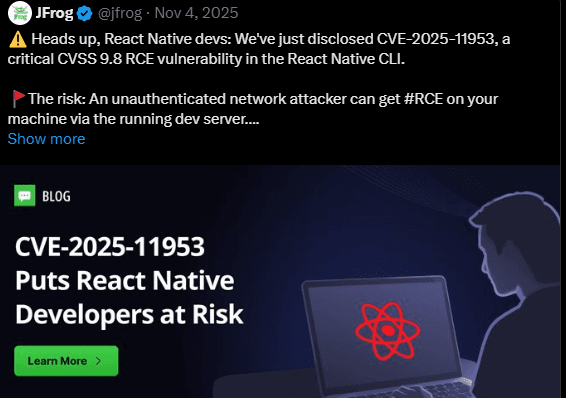
Attackers are actively exploiting a critical vulnerability in the React Native development toolchain to take full control of developer workstations — and the only thing they need is network access to a single HTTP endpoint. On February 5, 2026, the Cybersecurity and Infrastructure Security Agency (CISA) added CVE-2025-11953 to its Known Exploited Vulnerabilities (KEV) catalog, confirming that threat actors are leveraging the flaw in real-world attacks. With a CVSS score of 9.8 out of 10, this is about as severe as vulnerabilities get.
The bug lives in @react-native-community/cli-server-api, the package responsible for the Metro development server that hundreds of thousands of React Native developers rely on every day. A single unauthenticated HTTP POST request to the server's /open-url endpoint can execute arbitrary operating-system commands on the machine running the server — no credentials, no user interaction, no clicking required.
Security researchers at JFrog discovered that the Metro development server — the local bundler that React Native developers launch every time they run npx react-native start — contains a dangerous combination of two flaws. First, the server binds to all network interfaces (0.0.0.0) by default, meaning it is accessible not just from localhost but from any machine on the same network (or the internet, if no firewall intervenes). Second, the server's /open-url endpoint accepts a JSON POST body and passes the user-supplied url field directly to the third-party open NPM package, which in turn invokes the operating system's shell to "open" the URL.
On Windows, that shell invocation translates to cmd /c start "" /b <url> — and because the url value is never validated, escaped, or restricted to safe protocols, an attacker can inject arbitrary commands into that shell call. On macOS and Linux, the open or xdg-open utilities are invoked, which limits the attack surface but still allows abuse via crafted URI schemes.
The vulnerability was assigned CVE-2025-11953 and published on November 3, 2025. JFrog, which reserved the CVE, rated it 9.8 Critical. The React Native Community released a fix in version 20.0.0 of the CLI packages. But as VulnCheck's threat-intelligence team documented, exploitation in the wild began just weeks after the public disclosure — and it has not stopped.
At its core, CVE-2025-11953 is a textbook OS command injection (CWE-78) amplified by an insecure default network configuration. Let's walk through exactly how it works.
When a React Native developer starts the Metro bundler, the CLI launches an HTTP server. Among its routes is an endpoint called /open-url, handled by the openURLMiddleware function. In vulnerable versions, the middleware does something like this:
1// Simplified vulnerable middleware (pre-fix)2function openURLMiddleware(req, res) {3 const { url } = req.body;4 // No validation, no protocol check, no escaping5 open(url);6 res.end('OK');7}The open NPM package is designed to open a URL in the user's default browser. Under the hood, it constructs an OS-specific command:
cmd /c start "" /b <url>open <url>xdg-open <url>Because the url value is concatenated directly into the command string on Windows, an attacker can break out of the intended context and execute arbitrary commands.
The proof-of-concept published by JFrog demonstrates the attack in its simplest form:
1curl -X POST http://<target>:8081/open-url \2 -H "Content-Type: application/json" \3 -d '{"url": "cmd /c start \"\" /b calc.exe"}'When this request hits the Metro server, the open package dutifully passes the string to the Windows shell. The shell interprets it as a command and launches calc.exe. Replace calc.exe with powershell -EncodedCommand <base64_payload> and you have a full remote code execution chain.
The exploit only works remotely because of the second flaw: the Metro server's default bind address. When no --host flag is specified, the server starts with an undefined host argument, which causes Node.js to listen on 0.0.0.0 (all interfaces) and :: (all IPv6 interfaces). This means the development server — a tool intended for local use — is silently accessible from the entire local network, and potentially from the internet if the machine has a public IP or is behind a misconfigured router.
http://<target>:8081/open-url with a malicious url value in the JSON body.openURLMiddleware passes the string to the open package, which spawns a child process via the OS shell.The vendor patch, contained in commit 15089907d1f1301b22c72d7f68846a2ef20df547 (https://github.com/react-native-community/cli/commit/15089907d1f1301b22c72d7f68846a2ef20df547) and shipped in version 20.0.0, adds strict protocol validation to the /open-url endpoint. Only URLs with http:// or https:// schemes are now accepted; all other values are rejected before they reach the open package.
React Native Community |
| >= 4.8.0, < 20.0.0 | 20.0.0 |
React Native Community |
| >= 4.8.0, < 20.0.0 | 20.0.0 |
React Native is one of the most widely used cross-platform mobile development frameworks in the world. According to the 2025 Stack Overflow Developer Survey, it remains among the top five most popular frameworks for mobile development. The @react-native-community/cli package is the default command-line interface for React Native projects, and the Metro bundler it ships with is the standard development server for the ecosystem.
Any developer or CI/CD pipeline running a React Native project with the Metro server started on a network-accessible interface — which is the default behavior — is potentially exposed. This includes individual developers on corporate Wi-Fi networks, shared development servers, and automated build environments where the Metro server is launched as part of testing workflows.
Notably, projects using Expo's managed workflow are not affected, as Expo does not rely on the vulnerable Metro implementation from @react-native-community/cli-server-api.
This is not a theoretical risk. VulnCheck's threat-intelligence team documented active exploitation (https://www.vulncheck.com/blog/metro4shell_eitw) beginning on December 21, 2025, approximately six weeks after the public disclosure and patch release. The researchers observed multiple distinct attack waves:
The attacks, informally dubbed "Metro4Shell" by researchers, follow a consistent pattern: attackers send a POST request to /open-url containing a Base64-encoded PowerShell payload. The payload performs the following steps:
Add-MpPreference -ExclusionPath to evade endpoint detection.%TEMP% directory.VulnCheck identified the following C2 infrastructure IP addresses associated with the campaign:
65.109.182.231223.6.249.141134.209.69.1558.218.43.24847.86.33.195The payloads connect to these hosts on non-standard ports such as 60124 and 60130.
File hashes for the malicious binaries observed in the wild:
d8337df3aff749250557bf11daf069eb404cce0e6f4f91c6bd3f78aed6e9d67ecbb0cc88dfa5f187c209a28bd25e8e2d5113bb898a91ae273bca5983130886On February 5, 2026, CISA added CVE-2025-11953 to its Known Exploited Vulnerabilities (KEV) catalog (https://www.cisa.gov/known-exploited-vulnerabilities-catalog?field_cve=CVE-2025-11953), confirming active exploitation and classifying the vulnerability as:
For U.S. federal agencies, inclusion in the KEV catalog triggers mandatory remediation timelines under Binding Operational Directive 22-01. For everyone else, it should serve as a clear signal that this vulnerability demands immediate attention.
Successful exploitation gives an attacker arbitrary command execution with the privileges of the developer running the Metro server. In practice, this means:
The single most important action is to upgrade @react-native-community/cli-server-api and @react-native-community/cli to version 20.0.0 or later.
1npm install @react-native-community/cli@latest @react-native-community/cli-server-api@latestVerify the installed version across all developer workstations and CI/CD agents:
1npm list @react-native-community/cli-server-apiAny version below 20.0.0 is vulnerable.
If you cannot upgrade right away, force the Metro server to listen only on 127.0.0.1:
1npx react-native start --host 127.0.0.1This eliminates the remote attack vector entirely. The trade-off is that you will not be able to access the dev server from other devices on your network (such as physical test phones). For those scenarios, use USB port forwarding via adb reverse for Android or a secure tunnel.
Block inbound traffic to the Metro development server port (default 8081) at both the host-based firewall and the network perimeter:
netsh advfirewall firewall add rule name="Block Metro" dir=in action=block protocol=TCP localport=8081pfctl rules.sudo ufw deny in 8081/tcpMonitor for exploitation attempts using the following indicators:
Network-based detection:
/open-url on port 8081 from non-local IP addresses.65.109.182.231, 223.6.249.141, 134.209.69.155, 8.218.43.248, 47.86.33.195 on ports 60124 and 60130.Host-based detection:
cmd.exe or powershell.exe is spawned by a parent process of node.exe with command-line arguments containing start "" /b or -EncodedCommand.Add-MpPreference.%TEMP%.Log indicators:
POST /open-url requests, especially from external IP addresses.open(url) calls with non-HTTP/HTTPS URLs.netstat -tlnp | grep 8081 (Linux/macOS) or netstat -ano | findstr 8081 (Windows) on all developer machines to identify exposed Metro servers.package-lock.json and yarn.lock files across all projects for vulnerable versions of @react-native-community/cli-server-api.If your project's architecture permits it, consider switching to the Expo managed workflow, which does not use the vulnerable Metro implementation from @react-native-community/cli-server-api. This eliminates the attack surface entirely, though it may require changes to your project structure and development workflow.
CVE-2025-11953 is a stark reminder that development tools are part of the attack surface — and they are often the least hardened part. Developers tend to think of their local dev servers as ephemeral, harmless utilities. But when those servers bind to all network interfaces by default and expose endpoints that pipe user input directly into shell commands, they become high-value targets.
The root cause here is a pattern that security researchers have warned about for years: unsanitized input flowing into command-execution sinks. The open NPM package was never designed to handle adversarial input. It is a convenience library meant to open URLs in a browser. Using it as the backend for a network-exposed HTTP endpoint without any input validation is a recipe for exactly the kind of catastrophe we are seeing now.
The secondary issue — binding to 0.0.0.0 by default — is equally instructive. The principle of least privilege should extend to network interfaces. A development server that is only needed locally should only listen locally. The React Native community has acknowledged this, and version 20.0.0 addresses both the input validation gap and the network exposure.
Perhaps the most concerning aspect of this vulnerability is the supply-chain implications. Developer workstations are treasure troves of credentials, source code, and pipeline access. Compromising a single developer's machine can give an attacker the ability to inject malicious code into production builds — potentially affecting millions of end users who install or update the resulting mobile applications. The observed attack payloads, which include Defender evasion and custom compiled binaries, suggest that the threat actors behind Metro4Shell understand this and are building toward exactly that kind of supply-chain compromise.
As Szymon Rybczak, a React Native community contributor, noted on X (https://x.com/SzymonRybczak/status/1986199665000566848), the community moved quickly to address the issue once it was reported. But with active exploitation confirmed across multiple waves and CISA now mandating remediation for federal agencies, the window for complacency has closed. If you run React Native projects, check your versions today.

